


Compliance
Write the rule in plain English. Sign off what the engine will actually enforce.
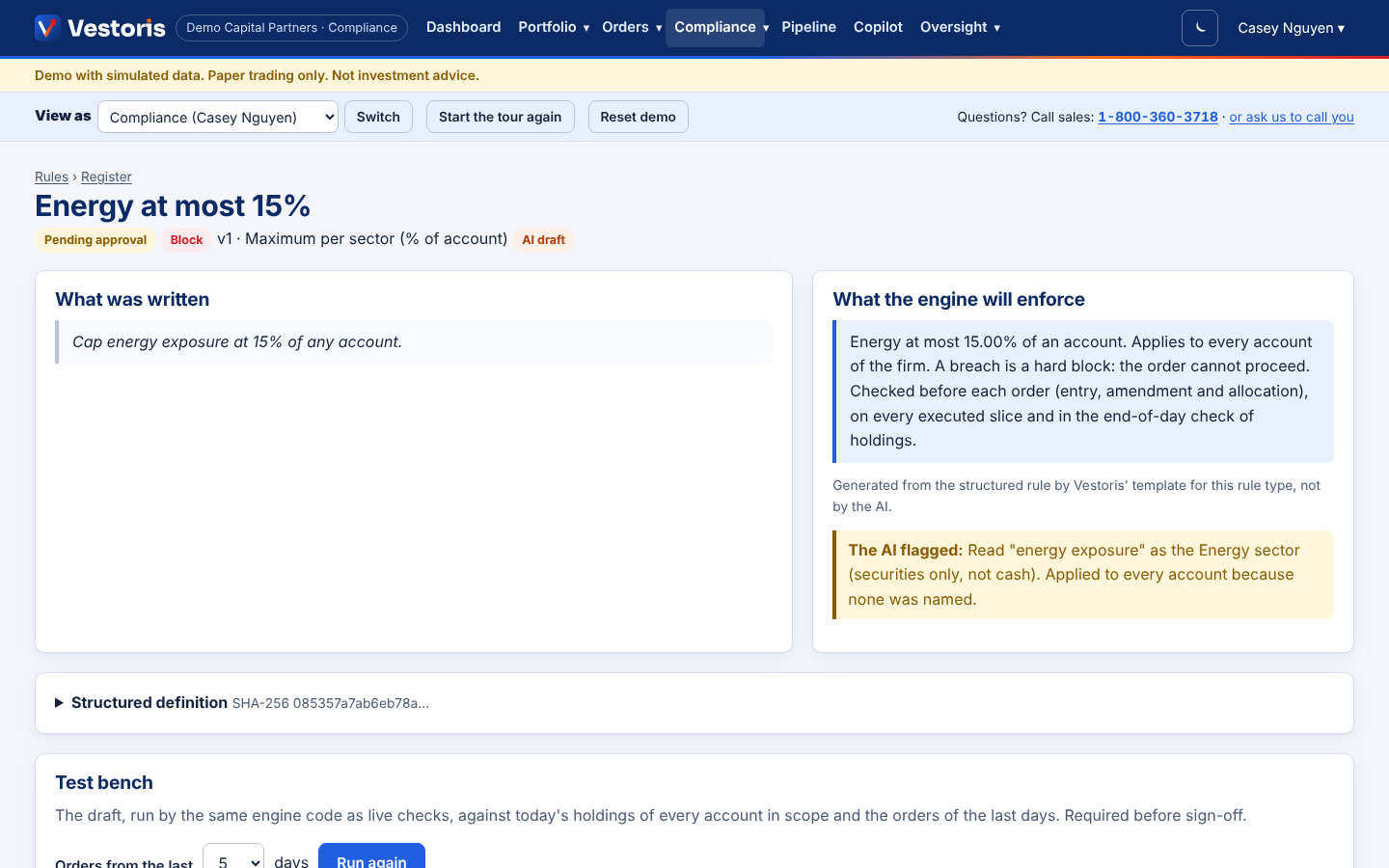
Twenty-five rule types, scoped to the firm, account groups, packages or single accounts, checked before, during and after the trade. Rules are written in plain English: the AI turns them into structured rules, asks when the wording is ambiguous, and says plainly when something cannot be expressed. A deterministic restatement shows what will be enforced, the test bench shows what it would block today, and a Compliance user signs off.
Twenty-five rule types
- Issuer, sector, position, country, asset class, security type and market-cap limits; top-N concentration; cash minimum and maximum; minimum and maximum holdings.
- Liquidity as a share of daily volume, turnover per period, gross exposure, maximum order size, fat-finger price and size checks, duplicate orders.
- Restricted, exclusion (ESG, sanctions) and watch lists; wash sales across an owner group; short-sale bans; blackout windows by security or issuer.
- Conditions on the firm's own user-defined fields: "IG-ONLY mandates may not buy anything rated CCC or D".
Written in plain English, signed off by people
- Several rules in one sentence, or one at a time; the AI fills a strict schema and asks clarifying questions instead of guessing.
- The original wording sits beside a restatement generated by code from the structured rule - not by the AI - with anything the AI flagged highlighted.
- The test bench is required before sign-off: what the rule would block or warn on, and which accounts are in breach now.
- Sign-off by someone with "approve compliance rules" other than the author, with a reason and a password or Google confirmation; recorded with the exact version in the hash-chained event log.
Packages, scopes and run points
- Rule packages (Growth mandate, Conservative, ESG) assigned to account groups or accounts, with account-level exceptions.
- Hard block, soft warning with a written override reason (and Compliance approval above a threshold), or logged as information.
- Pre-trade at entry, amendment and allocation; in-trade on every simulated slice; post-trade in the end-of-day batch, with active and passive breaches told apart.
Violations, versions and reports
- Each violation is owned, aged and moved through open → acknowledged → resolved, waived with a reason, or escalated.
- Every change is a new version with effective dates and a diff; retiring a rule needs a sign-off too.
- A rule register (wording, restatement, versions, approvals, test-bench snapshot, violations) and periodic reports, exported as PDF.
AI
Where the AI helps
- Turns plain-English rules, or a pasted mandate (each candidate quoting its exact source sentence), into structured drafts.
- Reviews a package's mandate for gaps, triages open violations and writes the daily compliance brief.
- Explains a failed check and proposes a version of the order that the engine has re-checked.
Deterministic
What decides
- The rule engine decides pass, warn or block; ~50 rules are checked in milliseconds.
- AI output is validated against the schema; anything invalid is rejected with reasons and never saved.
- Drafts never apply: test bench, sign-off by another person, then the effective date.
See it with your own eyes, in ten minutes.
Open a private sandbox firm with sample accounts, rules and orders. No sign-up, no email. Switch roles and follow the guided tour.